Wolf-girl
Train DreamsThe wolf-girl is a figure who moves from reported monster to intimate revelation. She is discussed by men who have never securely encountered her, associated with wolves, hybrid offspring, blood, and moral contagion, and finally seen by Robert Grainier in the clearing outside his cabin. There he recognizes the injured, animal-like child as his daughter Kate, though she has become, in the most devastating sense, Kate no longer. Her story gives physical form to the novel's uncertainty about what survives catastrophe and whether human identity can endure outside human society.
Rumor, Testimony, and Local Legend
The wolf-girl first exists as a story transmitted through informal male networks rather than as an established fact. Peterson, a surveyor for Spokane International, tells Grainier that his dog may have been confabulating with a wolf-girl person. Peterson's account is already several steps removed from direct knowledge: Kootenai Bob had told him that the dog had gone into the woods for thirteen days, returned nearly wild, and seemed to carry the wolf-girl's image in its eyes. Bob had therefore urged Peterson to shoot the animal before it brought the creature into his house and made him prey for wolves.
The legend accumulates sensational details as it travels. Peterson repeats that the wolf-girl had been seen leading a pack and that a visitor from Seattle had observed a bloody mass hanging between her legs. The witnesses, however, are not dismissed as obviously unreliable. The sheriff examines the people who claimed to have seen the creature and finds them frank and sober, judging from their testimony that the apparition is female. This official confirmation does not clarify the matter; it intensifies the community's fear by giving the rumor a provisional public reality.
The story then becomes a vehicle for collective speculation. People fear that the wolf-girl will give birth to more hybrid pups and that these wolf-people will multiply, attract the Devil's desire, and bring evil influence over the region. The Kootenai people are themselves folded into the hostile fantasy, with outsiders imagining that their supposed attachment to pagan and superstitious practices will make them especially vulnerable to Satan. The rhetoric escalates toward the belief that only fire and blood can cleanse the valley, turning an uncertain animal-human figure into a pretext for imagined communal violence. Yet the political season eventually redirects attention toward the silver standard and the railroad land snatch, and the mystery is temporarily forgotten. The legend survives not because it is proven, but because it gives social fear a memorable body.
The Wolf-Girl in an Animal World
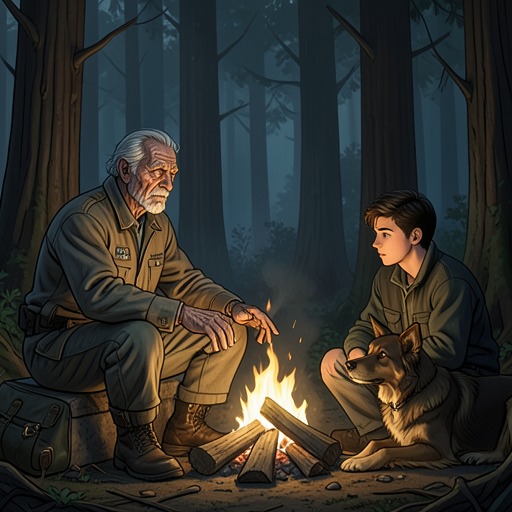
The rumors gain force from a landscape in which the line between domestic and wild life is already unstable. Grainier keeps a red-haired female dog after the great fire; she wanders, returns, and eventually produces four pups that look strikingly wolfish. Kootenai Bob explains a Kootenai belief that only the chief wolf mates within a pack and that only one she-wolf bears litters. Grainier wonders whether the wandering dog might have encountered the king wolf at the moment she came into heat. Bob allows the possibility that Grainier has a dog-of-wolf and may have started his own pack.
The surviving male pup does not behave according to the identity Grainier attributes to it. It never answers the distant wolves, even when Grainier howls beside it and tells it that its nature is to howl when the others do. The pup disappears before autumn, and Grainier hopes it has crossed into Canada, though he must also imagine that it became food for a hawk or coyotes. The episode supplies a smaller, almost domestic version of the wolf-girl's problem: an animal may possess a mixed origin without displaying the expected signs of belonging, while a human observer tries to impose a nature upon it.
Dogs throughout the surrounding country are credited with rescues, tricks, supercanine intelligence, and humanlike understanding. A prospector survives a dynamite explosion because his dog makes such a nuisance of itself at a saloon that men follow it home; another man, Peterson, is shot by his own dog after the animal returns from its mysterious absence. Later, the theater show Grainier attends presents a masked wolf-boy as entertainment. These episodes make the wolf-girl part of a wider culture of stories in which animals act with human intelligence and humans approach animal behavior with fear, wonder, or commercial curiosity. The wolf-girl is therefore not an isolated supernatural anomaly. She is the most extreme figure in a regional imaginative ecology already crowded with cross-species possibilities.
The Encounter in the Clearing
The wolf-girl's physical appearance is revealed during the aftermath of Kootenai Bob's death beneath a train. As the Kootenai people search the tracks for pieces of their dead brother, the Great Northern train moves slowly through the area, sounding long whistle blasts so that the search can continue. The whistles rouse coyotes and wolves, and the red dog is somewhere outside Grainier's cabin. On the fullest night of the moon, the animals howl without letup, in a chorus that seems to include every creature with a voice along the mountains above the Moyea River.
The animals suddenly flood Grainier's clearing. Several brush against him as they pass, but all disappear except one. The remaining creature is hurt and lies panting on its side. In the moonlight Grainier first understands its general shape as human: a female child with a delicate little-girl structure. Yet her limbs are bent, and her breathing makes a whistle or squeak like that of a frightened pup. When he approaches with a hurricane lamp and a club, the surrounding valley falls silent, leaving only his steps and the creature's breathing. The scene turns the open clearing into a temporary chamber of terror, where the wilderness seems to have delivered an injured secret directly to his threshold.
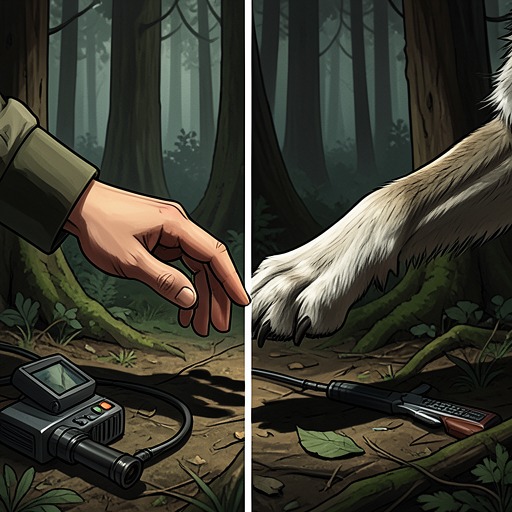
Under the lamplight, the child's eyes spark green like a wolf's. Her face is wolf-like but hairless. Grainier says, "Kate?" and asks whether she is his daughter, but nothing visible confirms the identification. His recognition is immediate and intuitive: he simply knows that this is his daughter. The discovery reverses the preceding folklore. What the community has imagined as an external monster is, for Grainier, the transformed remnant of the child who was believed to have died in the fire.
The recognition does not restore Kate to ordinary human identity. She lies with one leg broken, the bone splintered and protruding below the knee, having crawled on three limbs while dragging the shattered leg behind her. She has pulled most of her hair out, leaving only a few patches. When Grainier bends toward her, she growls, barks, and snaps; then she seems to fade from herself as though she has died, although she remains alive and watches him. Her eyes show terror rather than recognition. The father can name her, but he cannot call her back into the person she was.
Departure and Irreversible Change
Grainier does not simply rescue or domesticate the wolf-girl. He sits beside her, sleeps, and waits while she remains in the cabin, but at dawn she leaps through the window and leaves. From the window he watches her crawl and pause to twist sideways, snapping at the windings on her injured leg as a wolf or dog might. She follows the path toward the river. Grainier intends to track her and bring her back, but he never does.
That failure is central to the figure's significance. The encounter offers recognition without reunion, kinship without communication, and survival without restoration. Grainier's daughter has survived the fire, but not in a form that permits the family life he lost to resume. The phrase Kate no longer names both continuity and rupture: the creature is still Kate in the father's knowledge, yet no longer Kate in behavior, appearance, or reciprocal human relationship. Her departure leaves Grainier with certainty about her identity but no practical power over her fate.
The wolf-girl also changes the meaning of the great fire. Grainier had believed that the fire destroyed Gladys and Kate and even imagined that the Chinese laborer he had nearly helped kill had called down a curse that incinerated his family. The later appearance of Kate makes the catastrophe stranger rather than simpler. The child may have escaped death, but her survival is figured as a passage into the animal world, where the old categories of victim, daughter, human, and beast no longer hold securely.
Narrative and Thematic Significance
The wolf-girl is simultaneously a folkloric rumor, a feared female body, an ecological creature, and a private revelation of grief. The community's stories describe her through male testimony, religious panic, reproductive speculation, and fantasies of contamination. Her own voice is absent; what reaches others is panting, whimpering, growling, barking, and snapping. The absence of human speech does not make her meaningless, but it exposes how completely other people speak over her, converting uncertain observation into a legend about monsters and punishment.
Her appearance also links human loss to environmental transformation. After the fire, wolves answer one another across the peaks, animals return to the blackened valley, and Grainier's isolated homesite becomes a place where domestic companions and wild packs overlap. Years later, the wolves grow fewer and more distant while coyotes multiply, rabbits decline, and trout disappear from stretches of the Moyea River. The wolf-girl belongs to this changing animal geography rather than to a stable supernatural realm. She arrives amid a vast nocturnal chorus and leaves along the river, remaining partly within the world's damaged ecology and partly within Grainier's memory.
For Grainier, the wolf-girl is the most painful proof that survival need not resemble recovery. He can recognize his daughter only by an inward certainty that the creature herself does not confirm. He cannot make her human again, cannot follow her, and cannot convert the encounter into a public explanation. The legend's feared monster is therefore also the remnant of a family, and the private truth of the encounter is more terrible and more tender than the public rumor. Through the wolf-girl, the narrative refuses a clean boundary between human and animal and refuses the consoling idea that catastrophe leaves the lost either wholly dead or safely restored.